Markus Gabriel in Conversation with Masanobu Iwabuchi (Part I): Origin of Ethical Capitalism and the Promise of Japanese Business Management
2025.9.18
ENND Dialogue is a series of conversations hosted by Masanobu Iwabuchi, Co-Founder & CEO, and Tim Brown, Co-Founder & Principal Advisor, ENND PARTNERS Inc. Welcoming guests who are active in various domains from across the globe, we explore how to navigate business rooted in humanity in this increasingly uncertain world.
We kick off the series with a conversation between Markus Gabriel, a renowned philosopher, and Masanobu Iwabuchi, Co-Founder & CEO at ENND PARTNERS, to be presented in two parts. Part I of the conversation focuses on the concept of “ethical capitalism,” advocated by Mr. Gabriel, specifically where it came from and where it is going.

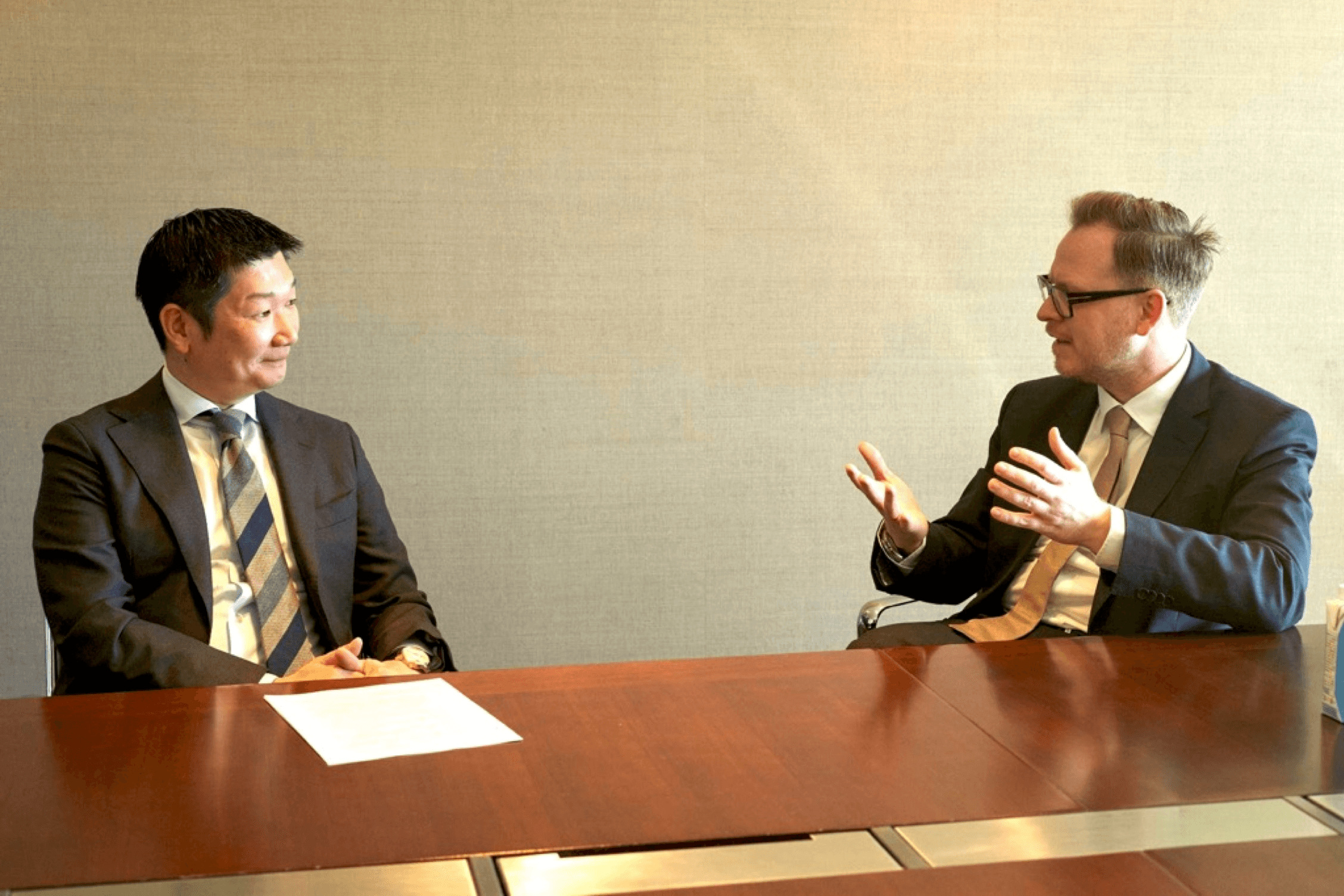
Left : ENND PARTNERS CO-Founder & CEO Masanobu Iwabuchi Right : Philosopher Markus Gabriel
Where did “ethical capitalism” come from?
Iwabuchi:
Today we welcome Mr. Markus Gabriel to talk about “ethical capitalism”*1. I am a consultant and concurrently a lecturer at a Japanese business school, where we discuss how to define a better form of capitalism, rather than flatly rejecting it. How did you come to think about ethical capitalism, Mr. Gabriel?
Markus:
It came as a result of several factors. One major factor was the opportunity I had to engage with Japanese academia in 2013. Prior to that, I had considered capitalism as something like a modern system of translating things into economic value. Through regular visits to Japan, I realized that capitalism comes in a variety of forms.
When I went to New York University in 2019 as a visiting professor, I often talked about the evolution of morality with philosopher Thomas Nagel, who was also teaching in the doctoral program. At that time, we were considering how to institutionalize anti-racism and gender equality. Then came the Covid-19 pandemic.
Iwabuchi:
What was in your mind when the world was locked down?
Markus:
We had to shut down social and economic activities for a while as borders, schools, restaurants and hotels were closed to protect society from the virus. It made me realize how ethical issues and economic issues are closely intertwined.
In the meantime, I was invited to a new research institute established in Hamburg, Germany with private funding. This institute is known as a forum for discussion on capitalism, standing at the crossroads of business, philosophy and politics. At the time, most ministerial posts in the German government were held by people who had specialized in philosophy, so they tended to view capitalism with a certain degree of critical skepticism. I was also asking myself: “What is required to overcome capitalism?” But as you said at the beginning, I came to the conclusion that flatly rejecting capitalism is not only impossible, but ethically undesirable as it would cause poverty and hunger on a far larger scale.
Then I started to read a number of books on philosophy and economics with an affinity for capitalism. Those included not only neo-liberalists such as Milton Friedman and Friedrich Hayek but also Amartya Sen, an Indian economist and philosopher, and in recent years Hirofumi Uzawa, a Japanese economist.
Iwabuchi:
The concept of ethical capitalism was not born overnight but formed through various events and discussions, wasn’t it? Could you explain how you have built and developed the construct of ethical capitalism?
Markus:
My approach to philosophy, known as “synthetic philosophy,” focuses on synthesizing different elements in a logical way. I adopted the same approach when thinking about the relationship between ethics and capitalism.
In short, my research focuses on exploring X in the equation: capitalism + X = good. And I concluded that the X was ethics. For if there is good and bad capitalism, something that makes capitalism good would be ethics.
Iwabuchi:
So, you condensed something complex into a very simple equation.
Markus:
Exactly. Finding out patterns is my way of doing things. For instance, Aristotle said that philosophy is about finding analogous relationships. He invented the words“Economics” and “Ethics” and related them to each other. Building a good household concurrently entailed a theory of domestic finance and the cultivation of character.
*1 A new form of capitalism advocated by Markus Gabriel to aim for a sustainable society by linking moral behavior with economic gains. In his book “Doing Good: How Ethical Capitalism Can Save Liberal Democracy,” Mr. Gabriel argues that sustainable growth will come to those companies conducting fundamentally ethical business activities in their own ways, and not to those which only comply with social rules and follow the trends of other companies.
Rapidly rising ethical sensitivity among world executives and the promise of Japanese companies
Iwabuchi:
Talking with the executives of leading companies these days, I cannot help but feel that the era of companies simply focusing on growth has come to an end. Business leaders appear to be struggling to find the direction to follow amid armed conflicts, disruptions to supply chains and digital innovation. So, I’d like to ask you, how has the world responded to your proposal of ethical capitalism, and how has the response changed in the last few years?
Markus:
I have had discussions on this theme in a number of countries in recent years, including Germany, Switzerland, Japan, France, Italy, the Netherlands and Nordic countries. Conversations with national governments and businesses in particular show rising sensitivity to ethical matters along with climate change. I very rarely see a top executive who really doesn’t care about ethics. Even the purest of businesspeople now admit that the future of capitalism should be ethical.
Iwabuchi:
That means the importance of ethics is now recognized regardless of the country or culture involved. Let me also ask some questions about Japan. In recent years, ethical business management has become a major topic of my conversations with Japanese company executives. This previously unseen development has particularly accelerated in the last couple of years. I strongly feel that an increasing number of companies are now taking action to strike a balance between profit maximization and ethical good. What kind of promise do you think Japan holds in terms of ethical capitalism?
Markus:
Japan has its own characteristics. First of all, democracy is deeply rooted in Japan. It also has a stable political framework, with the integration of liberalism and democracy established over the years. This is not limited to the period after the Second World War. Rather, I think that Japan has been developing democracy on its own, since at least the Meiji period.
And here lies one specific characteristic of Japan. Japan is a unique country capable of considering the economy and political society 10 years ahead. In the United States, decision-making typically operates on a week-to-week basis, while in Europe, it generally looks ahead about four years. In contrast, China seems to take a hyper-long-term perspective covering centuries.
Every time I visit Japan, I feel a gradual increase in ethical sensitivity among people. This gradual increase is very interesting to me – it might be closely related to the unique business model and employment structure in Japan.
If you seek to plan 100 years ahead, you might end up suppressing freedom, but planning 10 years ahead should help promote freedom in an appropriate, incremental manner. Realizing ethical capitalism entails a long journey that is neither ephemeral nor permanent. And that’s where Japan has excellent promise.
Iwabuchi:
It is true that Japan is home to the largest number of century-old companies in the world, including Hakuhodo with its 130-year history. Japanese companies indeed offer rich ground for studying the cultural dimensions that shape both economic infrastructure and visions of the future.
How to bring ethical and philosophical perspectives into Japanese business management: the role of CPO
Iwabuchi:
You just mentioned the promise of Japanese companies in realizing ethical strength, but I feel that we still lag behind in some aspects of management. We definitely have a lot to learn from the Western system particularly in terms of strategy and governance. We aim to support the development of systematic approaches and organizational structures, rather than relying on a highly personalized, one-man management model. What kind of trade-offs do you see between the introduction of Western-style management approaches and ethical capitalism?
Markus:
That’s a good question. Creativity in business is about finding sources of value visible to no one else. But it’s impossible to predict those sources as they keep shifting amid volatile consumer behavior, geopolitical realities and the changing natural environment. Nonetheless, businesses always manage to shape the future. Ethics may be considered as a philosophical discipline to help shape the future.
I advocate the concept of “Chief Philosophy Officer (CPO)” to integrate ethics and philosophy into governance in this way. It does not literally mean to position a gifted “philosopher” inside the company. Rather, I’m talking about building a system for investigating ethical matters as part of the corporate culture and analyzing relationships with external stakeholders including consumers and supply chains.
Iwabuchi:
That’s interesting. What actions should a CPO take exactly?
Markus:
The CPO should ask one question every time: “Is this the morally right thing to do?” Sometimes we may not know, or will never know, if something is morally right. It might be better to imagine an ethical spectrum, ranging from “definitely wrong” to “definitely right” so that we can objectively measure where a certain aspect of the company stands on the ethical spectrum. Such a mechanism will enable the management team to improve their strategy from the ethical perspective, by constantly analyzing and evaluating concrete data to elucidate why turnover is higher among female employees, for example.
Iwabuchi:
So, the CPO is not there to search for absolute goodness but to find a good balance between specific business issues and solutions by building a mechanism for research, analysis and assessment. Were you inspired by any specific cases?
Markus:
Bhutan’s Gross National Happiness (GNH) is an inspiring case. I actually worked with Karma Ura, the inventor of GNH, to study this indicator, which I think is a very good measure of happiness among the Bhutanese. Of course, we can’t apply the same indicator to Japan given the differences in cultural foundations and social systems between the two countries. Still, GNH serves as an excellent reference as it demonstrates the possibility of measuring a culture-specific phenomenon.
Continued in Part 2.
Markus Gabriel
Philosopher
Born in 1980, Markus Gabriel studied in Bonn, Heidelberg, Lisbon and New York.
After becoming the youngest professor in philosophy in 2009 at the age of 29, he taught epistemology and modern philosophy at the University of Bonn, concurrently serving as Director at the International Center of Philosophy. Since 2020, he has been serving as special lecturer in philosophy and new humanities at The New School for Social Research in New York, while co-launching new research institutes with colleagues specialized in a variety of disciplines.
His books have been published in Japan, Argentina, Brazil, Chile, Germany, France, the United Kingdom, Korea, Mexico, the United States and many other countries, including “Why the World Doesn’t Exist,” “I am Not a Brain: Philosophy of Mind for the 21st Century,” and “The Meaning of Thought” and “Moral Progress in Dark Times: Universal Values for the 21st Century.”
MASANOBU IWABUCHI
ENND PARTNERS CO-Founder & CEO
Masanobu Iwabuchi has served as co-lead of Digital BCG and Japan Leader of the Marketing, Sales & Pricing practice at Boston Consulting Group’s Tokyo office and has been a Corporate Officer of Hakuhodo DY Holdings since 2024.
In the past, he worked on numerous business strategy and digital transformation assignments in the high-tech, media & telecommunications, automotive, consumer goods, and energy industries for companies such as SoftBank, i2 Technologies, and McKinsey & Company. He is a frequent contributor and author to the Harvard Business Review and other publications. He is a member of the Ministry of Economy, Trade and Industry’s Study Group on Art and the Economy and Society. He has experience in global projects in more than 20 countries, including Europe, the Americas, and Asia.
