Markus Gabriel in Conversation with Masanobu Iwabuchi (Part II): Art, Not Economy, as the Driver of Human Civilization – The Future of AI and Creativity
2025.11.21
ENND Dialogue is a series of conversations hosted by Masanobu Iwabuchi, Co-Founder & CEO, and Tim Brown, Co-Founder & Principal Advisor, ENND PARTNERS Inc. Welcoming guests who are active in various domains from across the globe, we explore how to navigate business rooted in humanity in this increasingly uncertain world.
We kick off the series with a conversation between Markus Gabriel, a renowned philosopher, with Masanobu Iwabuchi, to be presented in two parts. Part II of the conversation focuses on the future prospects for artificial intelligence (AI) and the impact of art on the history of humanity.

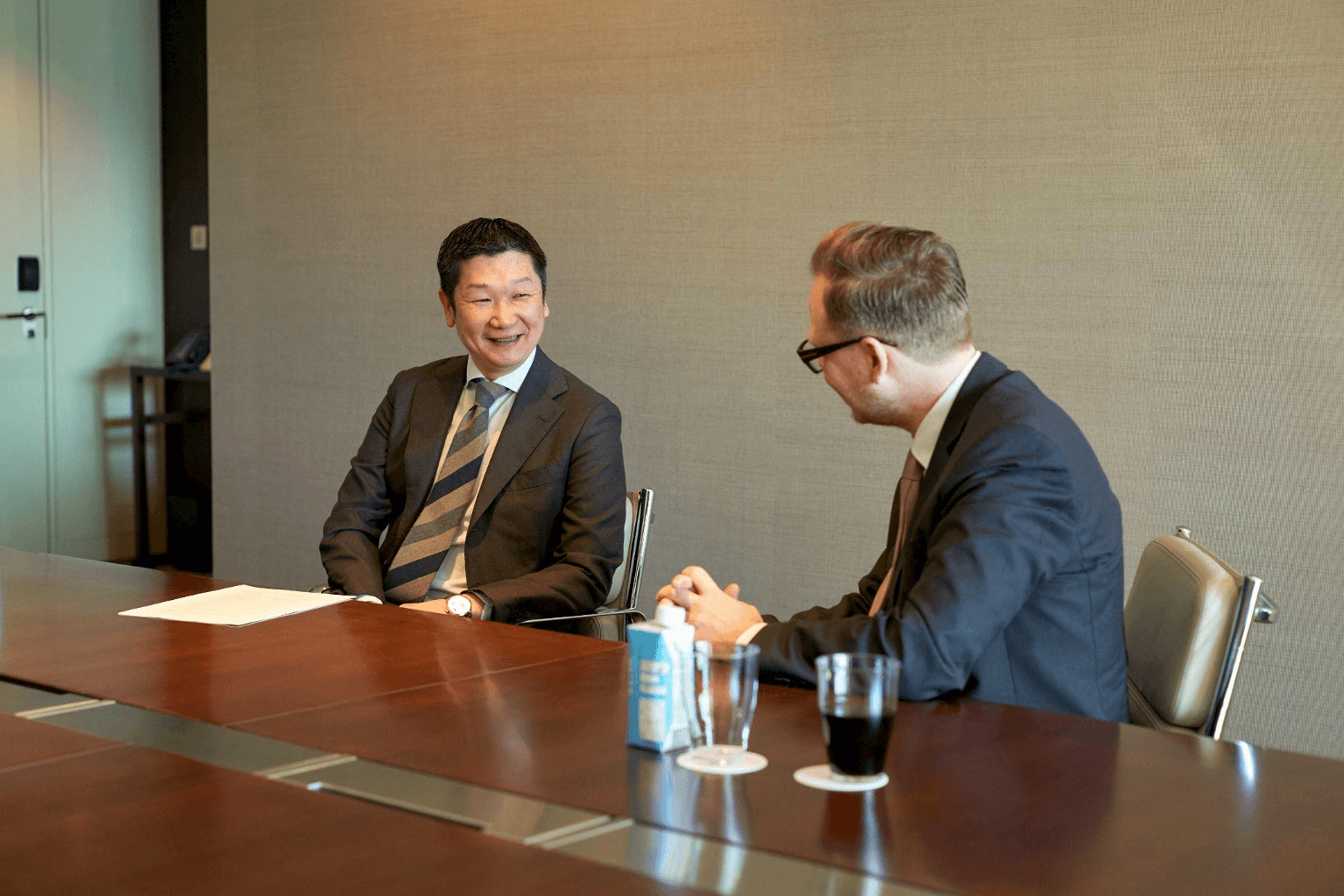
Left : ENND PARTNERS CO-Founder & CEO Masanobu Iwabuchi Right : Philosopher Markus Gabriel
Measuring human happiness with a mathematical formula
Masanobu:
We are working with our colleague Tim Brown, a world leader in design thinking, to integrate strategic consulting with design thinking. We believe that design thinking can be applied not only to products and services, but also to broader areas of business management such as strategy and innovation.
We also think that design has the power to provide insight into the whole of human society including people’s behavior, ideas and culture, in addition to creating something visible and tangible. That power might help implement ethical capitalism if brought into the entire process of business management.
Markus:
Yes. Similarly, how about bringing in humanities such as Japanology, Sinology, literature and art history, in addition to design thinking, to the study of human happiness, and then translating the findings into mathematics? The quintessence of modern science lies in transforming substance into mathematical expressions. This can also be done with AI, although no one has tried. In a sense, it would be an exploration into the structures and characteristics of culture, as well as the interactions between cultures.
Masanobu:
That’s an interesting idea. You would be a very successful entrepreneur.
Markus:
I wish! Actually, I am thinking about launching a start-up called Academy for Deep Innovation, Business, Politics, Science. I hope to build a system that will enable me and my trained staff to support other companies.
Masanobu:
Great. The involvement of someone like you in many companies will certainly help diffuse ethical capitalism.
I think that helping build a social system for Japanese companies to put ethical capitalism into practice is one of our roles at ENND. But what must Japanese companies do if they are to move in that direction?
Markus:
This may sound paradoxical, but laws and institutions would help. Businesses and the federal government tend to be in conflict with each other nowadays in the United States. That’s not the way it should be. Rather, businesses can propose ethical regulations at their own initiative and support the development of relevant laws and institutions. I believe we can build a better society if this type of action results in a cycle that ameliorates business activities on an ongoing basis.
Masanobu:
That is exactly what we are aiming for. We are determined to follow a practical approach to help Japanese companies shape the future of ethical capitalism.
Will the future of AI depend on us?
Masanobu:
One of the hottest topics of debate now is artificial intelligence (AI). In “Doing Good: How Ethical Capitalism Can Save Liberal Democracy” (Hayakawa Publishing Corporation, 2024), you say: “The AI system itself is not intelligent in any sense.” On the same subject, one of our experts in AI suggested that we could achieve more creative and strategic thinking with the help of AI. What would you say?
Markus:
I think it is basically the right idea. AI is a system capable of solving problems in a limited time. Algorithms can accelerate the speed and shorten the problem-solving process. It’s like an espresso machine can serve coffee faster than humans.
By allocating problems that can be solved automatically to AI, we can free up more mental resources. That is, the role of AI is not to supplant our intellectual capacity but to supplement it. The hybrid system of humans and AI will make us more intelligent. As a matter of fact, there is interesting data showing that the intelligence of children has actually improved since the pandemic in Germany.
Masanobu:
That’s amazing, but why?
Markus:
I think it is a secondary effect of the digital transformation. I was surprised to see the test my 9-year old daughter was taking, thinking “Is a fifth-grader supposed to be able to solve these questions?” To my further surprise, all of her classmates were rated A in that test. This is not because the system is getting more intelligent; it is humans who are getting more intelligent. In short, she belongs to a generation that grows with AI (*1).
So, what’s happening now is that we are wondering what to do, surrounded by a sea of intelligence. We might be able to evolve if we can improve the intelligence of humans, but dark intelligence might emerge on the way.
Masanobu:
Tim answered the same way when I asked him a similar question. Technology can have both positive and negative impacts, as demonstrated by the Internet and social media. For instance, the Internet has helped democratize information while causing problems through the spread of fake news and information overload. Many have pointed out the negative impacts of social media on mental health.
Markus:
That’s right. We still don’t know if AI will move in the right direction. But it’s not up to AI to decide. It’s up to us users to shape the future.
*1 Douglas Adams, known for his work “The Hitchhiker’s Guide to the Galaxy” (Pan Books, 1979), argues that we consider something as given if it exists when we are born, as inspiring and revolutionary if it is invented when aged 15-35, and contrary to natural laws if it is invented after age 35. If this argument is correct, AI might be a natural part of daily life for the younger generation, while being a source of concern for adults.
Combination of indigenous knowledge and technology as the key to sustainable value creation
Masanobu:
The industrial structure of Japan has changed in the last three decades. Thus, the drivers of Japanese industry have shifted from banks, automobiles and other manufacturers to B2B manufacturing, semiconductors, IT service and trading companies. Given this change in portfolio, do you see any industries or disciplines that should be prioritized if Japanese companies are to embrace ethical capitalism?
Markus:
It is important to diversify a portfolio in general, because that is a mathematically safe strategy. But there are exceptions, of course. The AI revolution is underway, with many uncertainties about the future structure of industry. It’s like everyone is at the casino.
Masanobu:
We have no choice but to bet and see the outcome!
Markus:
Now that we are faced with an ecological crisis, it is also crucial to combine indigenous knowledge with technology. The other day, a researcher at Waseda University showed me a demonstration of Nukabot, an AI-powered bot that can measure the health of rice bran. This is a beautiful art project combining the wisdom developed by rice bran pickles, a traditional Japanese food, with techniques of modern science.
Pre-modern wisdom contains knowledge about sustainability. In particular, people in pre-modern Japan knew how to make the most of scarce resources. That’s why Japanese companies will have to examine what is genuinely Japanese, and how they might transform it into something valuable for people outside Japan going forward.
When it comes to food, simply exporting foodstuffs is not enough. If the Japanese diet is one of the factors behind the longevity of the population, Japanese food will significantly contribute to addressing the problem of nutrition across the globe. But this is only an example. Hybrid cars also came from a great idea originating in the Japanese automobile industry. Broadly speaking, we should consider “hybrid” as a way of thinking. In this sense, Japan is home to a hybrid culture.
Art as a great inspirer of human civilization, beyond the economy
Masanobu:
Finally, I’d like to talk about art. This is a fundamental question, but why are you interested in art?
Markus:
I’ve been wondering when Homo became Sapiens in the history of mankind. According to anthropologists, it happened about some 200,000 years ago, when murals were painted in caves.
Actually, it took some 800,000 years for humans to draw cave paintings after they started to use fire, but innovation has been accelerating ever since. The most primitive art might have been handprints on the walls of caves. The free movement of hands made possible by walking on two legs represented a major turning point in the evolution of mankind. It is considered that humans at that time began by drawing their hands before animals and human bodies in recognition of that crucial importance.
Those cave paintings were not simple pictures but a specific type of experience. Primitive humans who went into a cave with a torch in their hand had a visual experience like a rudimentary film, seeing wavering light and shade. I believe this immersive experience triggered the history of intelligence by acting on our neural structure.
In that sense, the history of mankind tells the history of art. Indeed, I think it is not the economy but art that has had the greatest impact on human civilization. As the title of his book “Trump: The Art of the Deal” (Random House, 1987) suggests, Donald Trump rightfully recognizes that fact. The 2024 film “The Apprentice” also depicts a scene where he comes to understand what art is through a conversation with Andy Warhol. The Trump Tower Hotel and his branding strategy, despite their bad taste, clearly indicate the impact of art on power.
Masanobu:
That’s an intriguing insight. I previously served as a member of the Study Group on Art and the Economy and Society, organized by the Ministry of Economy, Trade and Industry. I also contribute a regular column on art and socio-economic issues to Forbes Japan. Recently, I wrote an article connecting the mindset of top executives with the work of Édouard Manet. I was deeply moved by his painting A Bar at the Folies-Bergère when I saw it at the Courtauld Gallery in London.
Markus:
I believe Manet stands out as one of the most important painters among French artists. Pierre Bourdieu, the French sociologist renowned worldwide for his research on the relationship between social class and taste, also published an outstanding book on Manet using a similar analytical approach.
Masanobu:
I will get hold of it at the earliest opportunity. Thank you very much for today. I hope that you will support the implementation of ethical capitalism in Japanese companies.
Markus:
The pleasure was mine. Thank you for an inspiring discussion.

Markus Gabriel
Philosopher
Born in 1980, Markus Gabriel studied in Bonn, Heidelberg, Lisbon and New York.
After becoming the youngest professor in philosophy in 2009 at the age of 29, he taught epistemology and modern philosophy at the University of Bonn, concurrently serving as Director at the International Center of Philosophy. Since 2020, he has been serving as special lecturer in philosophy and new humanities at The New School for Social Research in New York, while co-launching new research institutes with colleagues specialized in a variety of disciplines.
His books have been published in Japan, Argentina, Brazil, Chile, Germany, France, the United Kingdom, Korea, Mexico, the United States and many other countries, including “Why the World Doesn’t Exist,” “I am Not a Brain: Philosophy of Mind for the 21st Century,” and “The Meaning of Thought” and “Moral Progress in Dark Times: Universal Values for the 21st Century.”
MASANOBU IWABUCHI
ENND PARTNERS CO-Founder & CEO
Masanobu Iwabuchi has served as co-lead of Digital BCG and Japan Leader of the Marketing, Sales & Pricing practice at Boston Consulting Group’s Tokyo office and has been a Corporate Officer of Hakuhodo DY Holdings since 2024.
In the past, he worked on numerous business strategy and digital transformation assignments in the high-tech, media & telecommunications, automotive, consumer goods, and energy industries for companies such as SoftBank, i2 Technologies, and McKinsey & Company. He is a frequent contributor and author to the Harvard Business Review and other publications. He is a member of the Ministry of Economy, Trade and Industry’s Study Group on Art and the Economy and Society. He has experience in global projects in more than 20 countries, including Europe, the Americas, and Asia.
