Applying Human-Centered Management Reform to Achieve a Paradigm Shift from a Long-Term Perspective
2024.11.8
In March 2024, we established ENND PARTNERS to provide professional services for top executives.
Here, Co-Founders Tim Brown and Masanobu Iwabuchi discuss the core values of the company, which are human-centered design and management impact, and provide an overview of the business.

Left : ENND PARTNERS CO-Founder & CEO Masanobu Iwabuchi Right : ENND PARTNERS CO-Founder & Principal Advisor Tim Brown
Background to the Establishment of ENND PARTNERS
Iwabuchi :
Currently, setting agendas can be a complicated aspect of corporate management. Various decision-making themes need to be considered, such as the impact of climate change, societal divisions and conflicts, and the social impact of corporate activities. To address these wide ranging management challenges and achieve sustainable global growth, it is essential to boldly redesign management and the social framework from a human centered perspective.
The Hakuhodo DY Group, which has traditionally focused on advertising and marketing, is now pursuing a radical expansion of its business under the new Medium-Term Business Plan, with a further emphasis on client support based on Seikatsu-sha Insight. Members of HakuhodoDY Holdings’ strategic operating unit, kyu, have achieved notable success with a human-centered approach in Europe and the United States. We have now established a new company to extend this approach and create a greater social impact in Japan and various Asian countries.
Brown :
In the consulting industry, the“scientific” approach—applying analyses of past cases to current management situations—predominates. However, these days we face complex new challenges that can’t be solved by the scientific approach on its own. Instead, we need to strike an optimal balance that combines analytical knowledge, based on management science, with human-centered creativity. In my view, many traditional consulting firms haven’t been able to reconcile these two aspects.I believe that achieving equal integration between accumulating and advancing knowledge based on everyday consulting and human-centered creativity is the most important challenge facing management analysis. It also represents a significant business opportunity for us.
Taking a Three-Tier Approach to Stakeholders
Iwabuchi :
In my many conversations with corporate executives, one issue that consistently arises is the importance of people.Many companies are hiring specialized consultants and developing various strategies in specific areas such as digital and M&A.But the strategies they adopt as a result sometimes are not effective at accounting for people’s everyday actions, which makes problem-solving a challenge. That is why we make people our focus. We aim to strategically motivate people and support long-term business transformations based on insights into human nature. Mr. Brown refers to this as design in the broadest sense
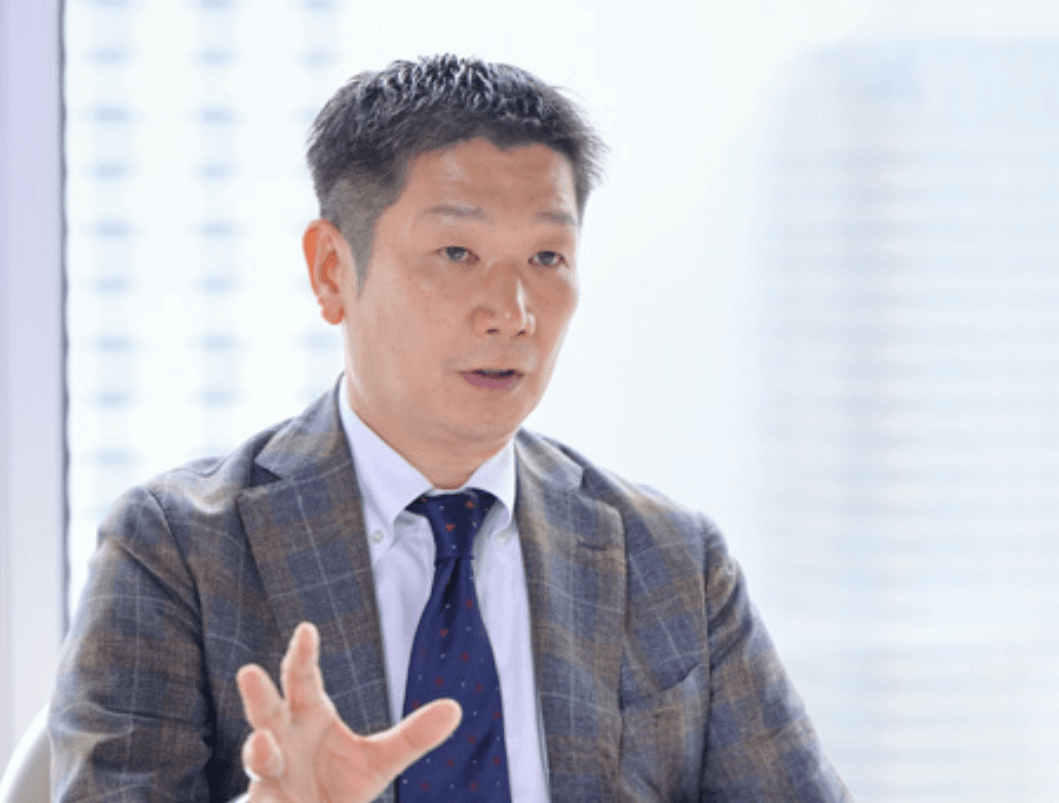
We support visionaryJapanese executives froma long-term perspective bydetecting portents of changebased on “human nature.” (Iwabuchi)
Brown :
We differentiate ourselves from consultants that take a planning-based approach of just creating ideal business presentations and leaving the rest to the client. Instead, we invite our clients to embark on a unique journey with us, immersing themselves in an experience that will lead to transformative actions. We strongly hope that our collaboration with clients will be an inspiring, enjoyable, and meaningful experience filled with inspiration.
Iwabuchi :
We refer to people as sei-katsusha, a concept that includes customers, employees, and company executives. We focus on these three stakeholder layer sand develop distinctive services for each.
In customer relationships, first we fundamentally redesign the management structure from the perspective of brand management.This approach is particularly well-suited to companies aspiring to global growth.
Next, we work to drive improvements in employee performance by stimulating individual creativity and promoting behavioral change, transforming the organizational culture and improving performance. This“activation” approach is employed bySYPartners, a member of kyu, in their work with global corporations.
Finally, we strive to enhance the experience of management. We work to support top executives who are driving reform amid numerous business challenges. To do so, we help set transformation agendas that incorporate the perspectives of both customers and employees. Additionally, our team, which covers a wide range of areas such as strategy, design, data, AI, and business processes, provides unusually comprehensive support.
Brown :
Today a lot of companies focus on responding passively to immediate challenges. Instead, they need to proactively consider their future vision and work relentlessly to achieve it, become more competitive through transformation, and strive to increase their integrated value. We want to support companies that have such aspirations. To a certain degree, Japanese corporate society has these qualities in place.There’s an inherent belief in constantly being aware of the social and economic impact of corporate activities, and striving for a better balance. This is one of the main reasons why I wanted to collaborate with Mr. Iwabuchi in this venture. I very much look forward to working with this sort of Japanese company
Driving Change Through the Power of Diverse Human Resources
Brown :
One of our company’s strengths is the diversity of our people. Mr. Iwabuchi and I, along with other team members, bring diverse experiences and achievements, each contributing rich insights into business reform. Furthermore, as part of the Hakuhodo DY Group, we collaborate closely with kyu. Leveraging diverse experiences within the Group allows us to drive more effective business reform from both the scientific (management science) and artistic perspective.
Iwabuchi :
Our members have broad and deep knowledge in such varied fields as design, art, business strategy, and organizational theory. We aim to attract individuals who have unique expertise in these areas or aspire to develop such expertise.
Our goal is to achieve new world-class practices, so we seek out individuals with a global mindset, respect for others, and proactive curiosity to continuously learn, even in areas outside their own areas of specialization. We hope to attract talented individuals who find joy in collaborating with diverse people around the world. Whether they come from academia, corporations, or the public sector, we welcome individuals who share our aspirations to join our community.
Iwabuchi :
There is widespread pessimism about the future of the Japanese economy.Recently, Japan’s GDP was eclipsed byGermany, a country with two-thirds its population. Taking a more positive view, I see this as evidence that the Japanese economy has ample room for improvement in terms of productivity and creativity.Japan’s has a high level of education and great potential. The problem lies not in the lack of talented individuals, but rather in the failure of companies to effectively harness the abilities of such individuals to create business value. This is where human-centered design plays a significant role. By incorporating elements that have traditionally been overlooked in corporate management, such as creativity and communication, it is possible to create a positive cycle where people can work energetically, productivity improves, and new businesses are born one after another. In this way, we can unleash the true potential of the Japanese economy and achieve greater value creation.
Brown :
Companies are profit-oriented organizations, but they’re more than just money-making machines. They’re communities that connect people and, in a sense, have structures that resemble living organisms. The executives who formulate strategies, make decisions, and manage day-to-day operations represent the “head” of the organization. Employees who execute strategies on the frontlines represent the “body,” but executives also have a physicality. Our proposed next-generation design thinking aims to connect the head and body, enhancing the morale of the entire organization and enabling truly human-centered purpose. This has the potential to generate a sense of fulfillment for employees and, in turn, have a positive impact on the company’s customers.

By applying the power of design to management and organically linking an organization’s head (top management) to its body (employees), we can foster organizations that excel at incorporating human nature and management impact.
(Brown)
Iwabuchi :
It is challenging to step outside the everyday time frame and look to the longer-term future. However, a wonderful world lies beyond. Working with visionary leaders, we aspire to explore ways of creating a more sustainable society and businesses where the younger generation can work joyfully and fully realize their potential.
Brown :
Each of us has a role to play in achieving a better society and economy. Each day, as we look to our clients and think of them as partners on a long journey, we aspire to contribute to leadership development that brings about transformation, whether from Japan to the world or from the present generation to future generations.

TIM BROWN
ENND PARTNERS CO-Founder & Principal Advisor
Tim Brown CBE is Vice Chair of kyu, the strategic operating unit of Hakuhodo DY Holdings, and Chair Emeritus of global design and innovation firm IDEO.
His best-selling book “Change By Design” has introduced design thinking to business leaders worldwide. Tim has written for Harvard Business Review, Fast Company and Rotman Magazine and his TED talks “Serious Play” and “Designers Think Big” have reached millions. His work focuses on creative leadership and the strategic application of design across sectors such as health, education, technology, mobility and global development.
MASANOBU IWABUCHI
ENND PARTNERS CO-Founder & CEO
Masanobu Iwabuchi has served as co-lead of Digital BCG and Japan Leader of the Marketing, Sales & Pricing practice at Boston Consulting Group's Tokyo office and has been a Corporate Officer of Hakuhodo DY Holdings since 2024.
In the past, he has worked on numerous business strategy and digital transformation assignments in the high-tech, media & telecommunications, automotive, consumer goods, and energy industries for companies such as SoftBank, i2 Technologies, and McKinsey & Company. Masanobu is a frequent contributor and author to Harvard Business Review and other publications. He is a member of the Ministry of Economy, Trade and Industry's "The study group on Art and Economy and Society." He has experience in global projects in more than 20 countries, including Europe, the Americas, and Asia.
